
Blog · From Our First Video
What Religion Did Abraham Follow? Submission Explained Simply
A short summary of our first video, in plain words, with examples from our daily life.
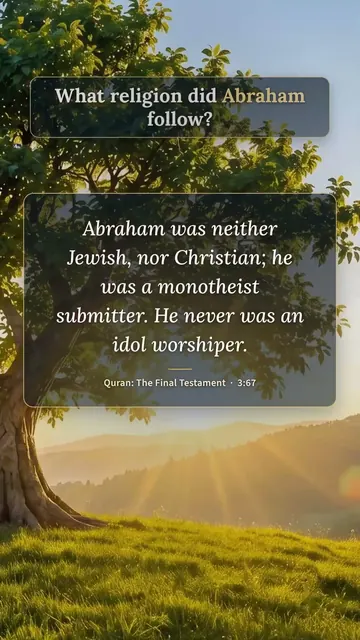
Abraham was neither Jewish, nor Christian; he was a monotheist submitter. He never was an idol worshiper.
[3:67]
Where We Began · 11 October 2026 · 15 min
What Religion Did Abraham Follow?
This post is a written summary of our first video, made before the weekly podcast started. You can read it here, and watch the full video whenever you have time.
In Short
Abraham followed Submission. He worshiped God alone, and he lived a righteous life. Every messenger after him brought the same message, from Moses to Jesus to Muhammad. Submission does not depend on the name we carry. It shows in the way we worship God alone and the way we live each day.
Most of us did not choose our religion. We were born into it, the same way we were born into our language and our food. There is nothing wrong with that.
But at some point, many of us start to ask what God Himself says about it. Our first video looked at that question through the life of Abraham. Let's go through what it said together, in four parts.
What Submission Means
Let's begin with one verse about Abraham:
Abraham was neither Jewish, nor Christian; he was a monotheist submitter. He never was an idol worshiper.[3:67]
God calls Abraham a monotheist submitter. Most of us know the Arabic words Islam and Muslim. Islam means submission, and a Muslim is a submitter. When we keep a word in another language, it slowly turns into the name of a group. When we say it in our own language, the meaning comes back.
God tells us “The only religion approved by GOD is ‘Submission.’” [3:19] And He tells us exactly who the submitters are:
Indeed, those who submit themselves absolutely to GOD alone, while leading a righteous life, will receive their recompense from their Lord; they have nothing to fear, nor will they grieve.[2:112]
So Submission has two parts. We submit ourselves to God alone, and we lead a righteous life.
Here is a simple example. A person can buy running shoes and call themselves a runner. But they only become a runner by going out and running, again and again. Submission works the same way. It shows in what we do every day, not in what we call ourselves.
The name itself goes back to Abraham. God tells us it is “the religion of your father Abraham. He is the one who named you ‘Submitters’ originally.” [22:78] So far, we have seen what Submission means. Next, let's see how far back it goes.
One Message From Every Messenger
Many people think every prophet brought a different religion. God tells us something different:
We did not send any messenger before you except with the inspiration: “There is no god except Me; you shall worship Me alone.”[21:25]
That “We” is God speaking. Every messenger came with the same message. Noah said “I have been commanded to be a submitter.” [10:72] Abraham and Jacob told their children “do not die except as submitters.” [2:132] The disciples of Jesus said “We have believed, and bear witness that we are submitters.” [5:111]
They lived at different times and in different places, and they spoke different languages. But they all described themselves the same way.
Think of a family recipe that is handed down for many generations. Each generation cooks it in its own kitchen, with its own pots. But the recipe stays the same. God tells us the message of the messengers was like that:
He decreed for you the same religion decreed for Noah, and what we inspired to you, and what we decreed for Abraham, Moses, and Jesus: “You shall uphold this one religion, and do not divide it.”[42:13]
So far, we have seen that every messenger brought one message. Next, let's look at the heart of that message.
God Alone, and the Quran Alone
God tells us why He created us: “I did not create the jinns and the humans except to worship Me alone.” [51:56] Please look at the word alone. Most people already believe in God, so what does alone add?
God tells us what people said about their idols:
Those who set up idols beside Him say, “We idolize them only to bring us closer to GOD; for they are in a better position!”[39:3]
These people believed in God. They only wanted someone in between, someone to speak to God for them. It could be a saint, and it could even be a prophet.
Think about it this way. When we want to talk to our own mother, we do not ask a neighbour to call her for us. We just call her. God is even closer than that:
When My servants ask you about Me, I am always near. I answer their prayers when they pray to Me. The people shall respond to Me and believe in Me, in order to be guided.[2:186]
We can talk to Him in the car or in the kitchen. We can talk to Him in the middle of a hard day at work, and He hears us.
The same goes for where our guidance comes from. God calls the Quran “this book fully detailed” [6:114], and He tells us “We did not leave anything out of this book.” [6:38] That “We” is God speaking. This is not about disrespecting the Prophet Muhammad. He was the one who delivered the Quran to us, and his complaint was “My Lord, my people have deserted this Quran.” [25:30] When we follow the Quran alone, we hold on to the message he delivered.
So far, we have looked at God alone and the Quran alone. Last of all, let's see what this means in our daily life.
Submission in Daily Life
The Contact Prayers (Salat), the obligatory charity (Zakat), the fasting and the pilgrimage all came to us through Abraham. God tells us that Muhammad was told to follow that same religion [16:123]. But the practices are only part of the picture. God tells us to say:
Say, “My Contact Prayers (Salat), my worship practices, my life and my death, are all devoted absolutely to GOD alone, the Lord of the universe.[6:162]
So our whole life belongs to God. Picture a cashier who gives back the extra change a customer did not notice. Or a mechanic who tells the truth about a repair, even when a bigger bill would pay more. Nobody else may ever know. But that honesty, done for God, is part of our Submission too.
And God tells us that this is open to everyone, whatever their background. Anyone who believes in God and the Last Day, and leads a righteous life, will be rewarded by their Lord [2:62].
Please do not take our word for any of this. God tells us “You shall not accept any information, unless you verify it for yourself.” [17:36] So please open the Quran and read these verses for yourself, with the verses before and after them. And please remember that “There shall be no compulsion in religion” [2:256].
We would like to end with God's own invitation:
Say, “O followers of the scripture, let us come to a logical agreement between us and you: that we shall not worship except GOD; that we never set up any idols besides Him, nor set up any human beings as lords beside GOD.” If they turn away, say, “Bear witness that we are submitters.”[3:64]
This is our invitation to you as well. Let's worship God alone, and let's never set up anyone beside Him.
Something to Try This Week
Please pick one verse from this post. Then read it with the verses before and after it, in the Quran reader on this website. A good place to start is [3:67] or [2:186].
Then take one minute in your day, wherever you are, and talk to God directly. As [2:186] tells us, He is always near.
Quick Answers
Here are the questions from the video, each with a short answer.
What religion did Abraham follow? Submission. He was a monotheist submitter [3:67].
What does Islam mean? Islam means submission, and a Muslim is a submitter [3:19].
Who named us submitters? Abraham did [22:78].
Did every prophet bring a different religion? No. Every messenger brought the same message [21:25].
Do we need someone between us and God? No. God is always near, and He answers us directly [2:186].
Is Submission only for people called Muslim? No. God looks at belief and a righteous life [2:62].
Shorts From This Video
Each Short is one question from the video, about a minute long. Please press one to watch it here.

Growth Prompt
Abraham, Noah, the disciples of Jesus and the Queen of Sheba all called themselves submitters. Please take a few quiet minutes and think about what that word asks of us today, at home and at work.
Is there someone or something I have been putting between myself and God?
Keep growing
Every topic on this site connects to the others. Here is where this page leads next.